300 Applicants per Hire: How to Get Out of the Pile in 2026
If your job search feels like shouting into a void, the numbers agree with you. Hiring data from Ashby, an applicant tracking system used by thousands of companies, shows the average hire now draws more than 300 applications, about three times as many as in 2021. Greenhouse, another large hiring platform, saw applications per job roughly double between 2022 and 2025, while the recruiting teams reading them got smaller.
There is a more hopeful number in the same data, and it changes how you should search.
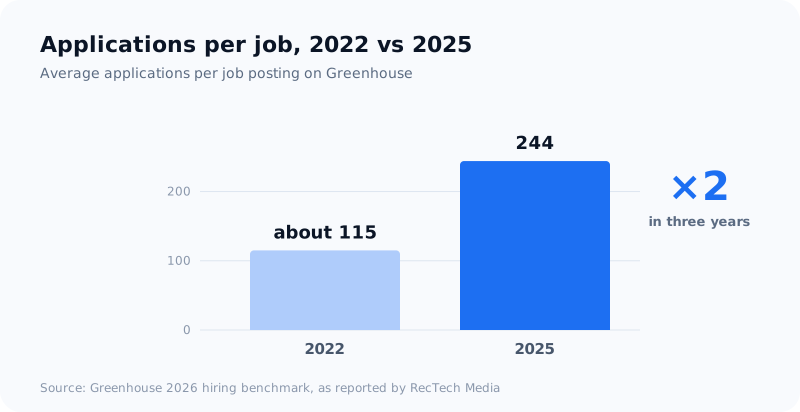 Applications per job roughly doubled in three years, while recruiting teams shrank.
The funnel, in figures
- More applicants, fewer screeners. Recruiters on Greenhouse handle several times more applications a year than they did a few years ago. Many teams now spend a large part of their week filtering out applications they consider junk.
- Getting an interview is harder. In Ashby's data, a candidate is about half as likely to reach an interview as five years ago.
- Once you are in the room, the odds are better than they used to be. Offer rates for people who reach interviews are higher than in 2021. Companies are interviewing fewer people more seriously.
- Searches are longer everywhere. In the US, more than a quarter of unemployed people have been looking for six months or more. Employers are cautious: few people are being fired, but few are being hired either.
- Remote roles are the most crowded. LinkedIn has said fully remote jobs made up a small share of its paid US postings but drew several times that share of applications.
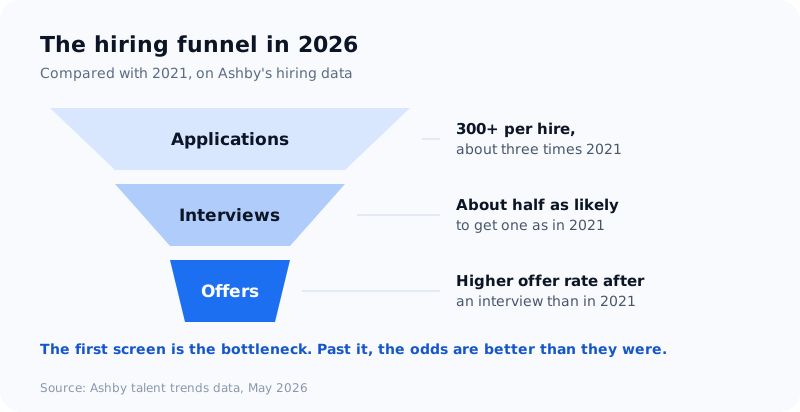
The bottleneck is the first screen. Everything after it works in your favour, so the job is to get through that one gate.
Why spraying applications backfires
Tools that write a cover letter in seconds and click "apply" on fifty jobs an hour have made the pile bigger without making anyone's chances better. Recruiters have responded with stricter filters, and a generic application is now easier to spot than ever. Sending more applications of the same kind mostly adds you to more piles you will not get out of.
What helps is fewer applications, each one clearly written for that role.
Where the odds are better
Apply early. A posting gathers most of its applications in the first days. A strong application on day one is read with fresh eyes; the same one on day twenty is number 250. Set alerts for the stack and seniority you want and apply within a day or two. (This is exactly what job alerts are for.)
Use referrals and direct contact. A referral skips the pile entirely at most companies. If you do not know anyone, a short, specific message to the hiring manager or someone on the team still goes further than another anonymous application.
Look past the obvious postings. Many companies, especially startups, publish roles only on their own careers page or their applicant tracking system. They draw fewer applicants than the same role syndicated to every big board.
Match the posting, honestly. Recruiters skim. If the role asks for Kubernetes and Go, the first third of your CV should make it obvious you have done both, in the words the posting uses, without inventing anything.
Pick where you can compete. A remote role open worldwide competes with the world. A remote role open to your country or time zone has a much smaller pool. Filter for roles that list where you live.
A weekly routine
- Monday: review new roles from your alerts. Shortlist five to ten that genuinely fit.
- Tuesday to Thursday: one or two tailored applications a day, each with a short note on why you fit this specific role. Look for one person to contact at each company.
- Friday: follow up on applications older than a week, update your tracker, and spend an hour on something that improves your profile: a small project, a write-up, a contribution.
Track every application with the date, the contact, the stage and the next step. A long search is easier to sustain when you can see it moving.
The bottom line
The pile is real, but it is the first gate, not the whole process. Fewer, better, earlier applications, plus every route that skips the pile, will do more for you than another fifty clicks.
Sources
- Ashby, application and hiring data, May 2026, and EMEA recruiter productivity report
- Greenhouse 2026 benchmark, as reported by RecTech Media
- Greenhouse, AI in Hiring report, November 2025
- US Bureau of Labor Statistics, Employment Situation, September 2026 and JOLTS
- LinkedIn figures on remote postings and applications, as reported by Business Insider, September 2025