AI or Just a Reorg? How to Read a Tech Layoff Announcement
Read enough layoff announcements this year and they start to sound alike: a leaner organisation, a sharper focus, and, almost always, artificial intelligence. AI has become the reason employers name most often when they cut jobs. That does not mean it is the reason the jobs went.
If you are looking for your next remote role, the difference matters. A company that has genuinely automated a function hires differently from one that moved its budget into data centres, and both differ from one that needed a respectable story for a cost cut it would have made anyway.
What the "AI-cited" number actually counts
The figure quoted most often comes from Challenger, Gray & Christmas, the outplacement firm that has tracked US job-cut announcements for decades. In its September 2026 report, employers had announced about 573,000 cuts since January, and AI was named as the reason for roughly 120,000 of them, around a fifth, more than any other single reason. Technology accounted for close to 166,000 cuts, 54% more than at the same point last year.
Two caveats change how those numbers read:
- It counts what employers say, not what happened. Challenger records the stated reason in an announcement. Nobody audits whether the work was really automated.
- It moves with the news cycle. AI led the list from March to July, then dropped to fifth place in September, when the firm's own commentary pointed to energy prices, geopolitics and interest rates instead.
Other researchers looking at the same period are more sceptical. Oxford Economics estimated that AI accounted for under 5% of US cuts in 2025, and noted that productivity growth has been too weak to fit a story of machines replacing people at scale. Yale's Budget Lab, which tracks occupations over time, has not found the shift in the job mix that broad AI displacement would produce.
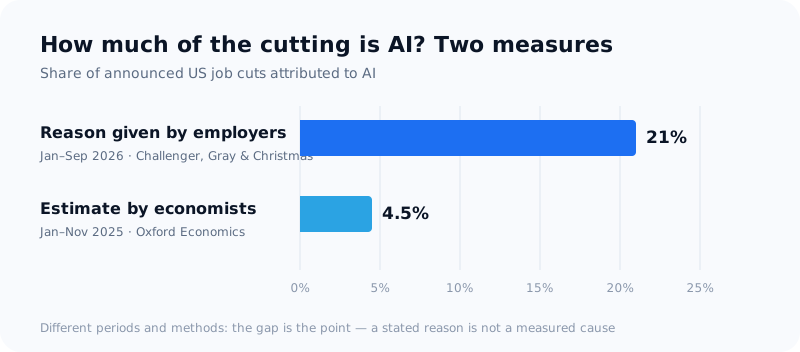 A stated reason is not a measured cause. Different periods and methods, so read the gap, not the exact figures.
Three patterns behind the announcements
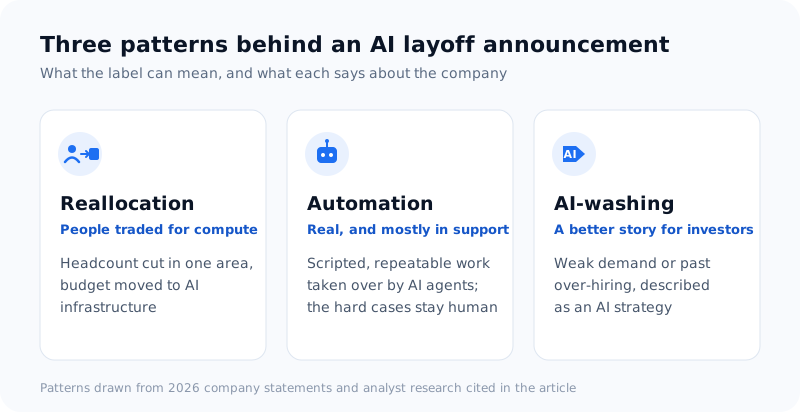
1. Cutting people to pay for AI
The largest technology companies are expected to spend somewhere around $700 billion on capital expenditure this year, most of it on AI infrastructure, a steep rise on 2025. That money comes from somewhere. Several of this year's large cuts are best read as reallocation: headcount in one area traded for compute in another. Meta, for example, cut around a tenth of its staff while moving thousands of employees into AI work. Microsoft said outright that the roles it removed were not being replaced by AI, and Cisco's finance chief described its cuts as moving resources rather than saving money.
What it means for you: the company is still investing, just not where you were. Teams building AI products, infrastructure and data platforms are often hiring inside the same company that is cutting elsewhere.
2. Real automation, mostly in support
Customer support is where the automation story has the most evidence. Salesforce's chief executive said support headcount fell from about 9,000 to about 5,000 as AI agents took over around half of customer conversations, and that the company stopped backfilling some support engineering roles.
Even here the picture is mixed. In a Gartner survey of customer service leaders, only about one in five said they had actually reduced staff because of AI. Klarna, one of the first companies to talk loudly about replacing support with AI, later said quality had suffered and began hiring people again.
What it means for you: roles built around repeatable, scripted work are under real pressure. Roles that handle the exceptions, the angry customer, the unclear bug, the enterprise account, are not going away as quickly as the headlines suggest.
3. "AI-washing"
Saying "we are becoming an AI-first company" plays better with investors than "demand is soft" or "we hired too many people in 2021". One survey of hiring managers (from a résumé site, so treat it with care) found a majority admitting they frame cuts as AI-driven because it lands better with stakeholders. Analysts at Gartner and Forrester both expect a share of AI-attributed cuts to be quietly reversed, the work rehired under new job titles, offshore or at lower pay.
What it means for you: the role may come back. Watch the careers page of a company that cut "because of AI" six months later.
What to check before you join a company that just made cuts
- Read the filing, not the press release. Annual reports and investor letters are more careful with words. Look for whether the company says AI replaced work or that it is investing in AI.
- Ask what changed in the team you would join. Was it cut, merged or grown? A team that absorbed two others is a different job from the one in the posting.
- Look for the money. If the company is spending heavily on AI infrastructure, the stable seats are close to that spending.
- Ask about the ratio. Several companies have flattened management; one dataset puts the typical engineering manager at about twelve reports, up from ten. Ask how many people your manager would have.
- Check whether the role was posted before. A role that disappears in a layoff and reappears months later under a new title is the reversal pattern in action.
The bottom line
AI is changing tech jobs, but the announcements overstate how much of this year's cutting it explains. Most of it is budgets moving, markets cooling and companies correcting earlier over-hiring, with AI as the most fashionable label. For a job seeker that is good news of a kind: the work is shifting, not vanishing, and the teams on the receiving end of the new budgets are hiring.
Sources
- Challenger, Gray & Christmas, September 2026 job cuts report and May 2026 report
- Oxford Economics, as reported by Fortune, January 2026
- Yale Budget Lab, Tracking the impact of AI on the labor market
- TechCrunch, running list of 2026 layoffs where employers cited AI
- Gartner, press release on customer service and AI, February 2026
- Forrester, Future of Work predictions 2026
- Salesforce support headcount, as reported by TechRepublic; Klarna rehiring, as reported by Entrepreneur
- SignalFire, State of Talent 2026