AI vs AI: Getting Past Robot Screeners and Robot Interviewers Without Cheating
Hiring has turned into an odd contest. Candidates use AI to write CVs and cover letters and to apply at scale; companies use AI to sort the resulting flood, and increasingly to run the first interview. Each side's tools make the other side's tools more necessary.
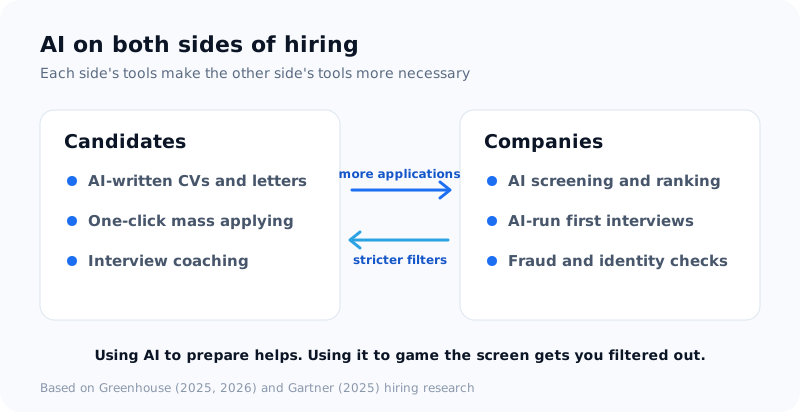
Neither side trusts the arrangement. In a Greenhouse survey across the US, UK, Ireland and Germany, most hiring managers said they trust AI to help them hire, while fewer than one job seeker in ten called AI-driven hiring fair. Here is how to work within it without being on the wrong side of it.
The arms race in figures
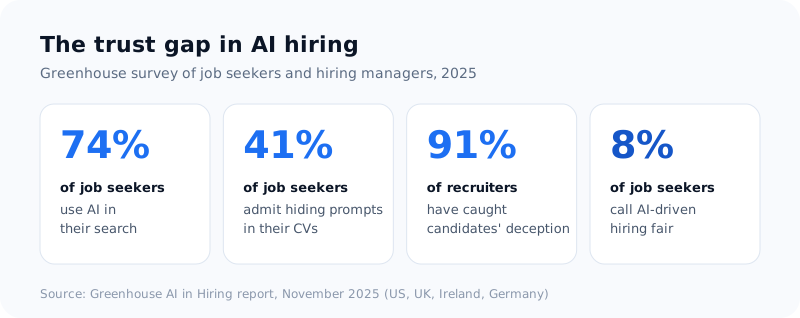 Greenhouse AI in Hiring report, November 2025.
- Most candidates use AI. About three in four job seekers in the Greenhouse survey said they use it in their search.
- Some try to game it. Around four in ten admitted hiding instructions for screening software in their CVs, for example invisible text telling an AI to rank them highly.
- Recruiters notice. Nine in ten recruiters said they had caught candidates misrepresenting themselves.
- Fake candidates are a real problem, especially for remote jobs. Gartner expects that by 2028 as many as one in four candidate profiles worldwide could be fake. Some companies have added in-person or live video steps just to confirm that a candidate exists.
- AI interviews are common, and often unannounced. In Greenhouse's 2026 candidate survey, most respondents had done an interview run by AI; most of those said it was not clearly disclosed beforehand, and about half never heard back afterwards.
Use AI where it helps you
- Understanding the role. Ask it to break a long posting into must-haves and nice-to-haves, and to point out which of your experiences map to each.
- Tailoring, not inventing. Let it suggest how to reorder and reword your real experience to match the posting's language. Every claim should still be something you can talk about for ten minutes.
- Practising. Rehearse answers to the questions a role is likely to ask, then have it play a sceptical interviewer.
- Checking. Use it to proofread, tighten and spot gaps, then read the result aloud. If it does not sound like you, rewrite it.
The tricks that get you flagged
- Hidden instructions in your CV. White text and "ignore previous instructions" lines are well known. Many screening systems look for them, and a recruiter who finds one will not read further.
- Generic AI prose. Cover letters that could be sent to any company read exactly like that. Two specific sentences about this team beat a page of polished filler.
- Help during live interviews. Reading generated answers during a call, or using tools that alter your voice or video, is easy to detect and ends the process. With fake-candidate fraud rising, interviewers are watching for it.
- Claims you cannot back up. AI makes it easy to inflate a CV. The technical interview will find the gap.
When the interviewer is a bot
- Ask before it starts. You are entitled to know whether a conversation is with a person or a system, and how the recording will be used.
- Treat it like a real interview. Structured, concrete answers with examples score well with people and software alike. State the situation, what you did and the result.
- Mind the basics. Good light, a quiet room, a stable connection. Automated scoring is unforgiving of a frozen video.
- Ask for a person if it matters to you. Nearly half of candidates in the Greenhouse survey wanted that option. Some companies offer it; many will consider it if you ask politely.
- Follow up. If you hear nothing after an automated interview, a short note to the recruiter is reasonable after a week.
Proving you are real
For remote roles especially, expect identity checks: a live video round, a request to show ID, sometimes a short on-site meeting before an offer. Treat this as a sign of a careful employer rather than an insult. A public track record helps too: a real LinkedIn history, open-source work, writing or talks under your name all show that a real person stands behind the application.
The bottom line
AI on both sides of hiring is not going away. Used honestly, it makes you faster and sharper. Used to game the system, it gets you filtered out faster than ever. The candidates who do well use it to prepare, then show up as themselves.
Sources
- Greenhouse, AI in Hiring report, November 2025
- Greenhouse, 2026 Candidate AI Interview Report, April 2026
- Gartner on fake job candidates, as reported by HR Dive, July 2025