Remote tech salaries: who shows the pay, and what the ranges say
Pay transparency laws in several US states, and the EU directive that takes effect from June 2026, were supposed to make salary a line in every job ad. In remote tech, it depends heavily on where the job is.
We looked at the 7,975 live remote tech roles in the Remly catalog and at the 1,885 of them, 24%, that publish a pay range.
Americans see the salary, Europeans mostly do not
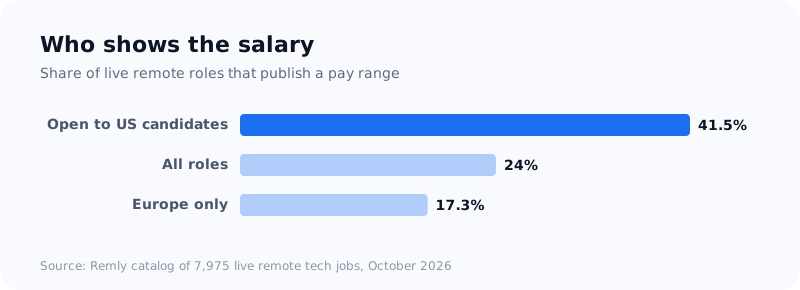 Share of live remote roles that publish a pay range
Roles open to US candidates publish a range 41.5% of the time. Roles open only in Europe: 17.3%. The difference is the law. Colorado, California, New York, Washington, Illinois and others require a range in job ads, and a remote role a company might fill anywhere in the US is usually written to comply everywhere. Most European countries have no such rule yet; the EU Pay Transparency Directive requires employers to tell candidates the pay before the interview, but member states are still writing it into national law, and it does not have to appear in the ad itself.
The ranges themselves
Among published ranges, the median top of the range is $220,000 for roles paid in dollars, and €72,000 for roles paid in euros.
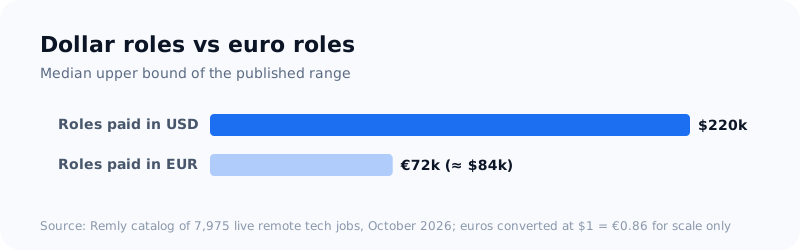 Euros converted to dollars only to put the bars on one scale
Two warnings before anyone books a flight. First, the dollar side of our catalog is dominated by venture-funded US startups, which pay at the top of the market. Second, a US salary comes with US costs that a European salary covers through taxes: health insurance, and in many cases far less paid leave. The gap is real, but it is smaller than the headline ratio.
The ranges are also wide. The median band spans 27% from bottom to top, so a role listed as "$180k–$230k" is common. The top of the range is what the company is prepared to pay the strongest candidate; most offers land in the middle.
By role
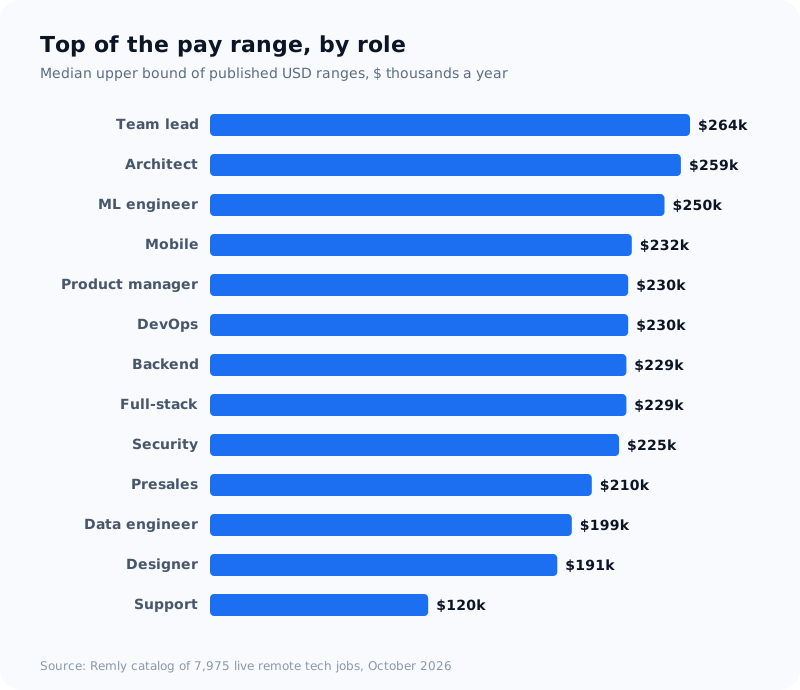 Published USD ranges only
Engineering roles cluster tightly: backend, full-stack, mobile, DevOps and security all sit between $225k and $232k at the top of the range. Machine learning engineers are a step higher at $250k, and leadership roles, team leads and architects, higher again. Data engineering ($199k) and design ($191k) trail the engineering pack, and customer support, at $120k, is a different market altogether.
By seniority, the median top of the range goes from $190k for roles at a middle level to $224k for senior and $242k for lead roles.
What this means for your search
- A missing range is information too. In Europe, most roles will not tell you. Ask early, in the first call, so neither side wastes three interview rounds.
- Anchor on the middle of a range, not the top. If you have most of what the role asks, the midpoint is a realistic target; the top is for the candidate who exceeds it.
- Compare total cost, not just numbers. A US contract role with no benefits and a European salary with health care and 25 days of leave are not comparable at face value.
- Use the US ranges as a reference even if you cannot apply. They are the largest public data set of what companies actually budget for a role, and they show where your role sits relative to others.
How we counted
- The data. Every live job in the Remly catalog on 20 October 2026: 7,975 remote tech roles. About nine in ten come from the public job boards of roughly 3,000 companies that hire through Ashby, an applicant-tracking system popular with venture-backed startups; most of the rest come from WeAreDevelopers. That makes the sample lean towards US startups and scale-ups. It is a snapshot of what is open now, not a survey of the whole market.
- Locations are the countries and regions an employer says it accepts. "Anywhere" means the posting names no country at all.
- Salaries are only the ranges employers published themselves; we do not estimate missing pay. Where we compare dollars and euros, we convert at $1 = €0.86.
- Levels are read from job titles, so a role titled simply "Backend Engineer" counts as having no level, even if the description asks for eight years of experience.